Maps
Visualize Data Using Weave
Neighborhood Nexus is a member of the Open Indicators Consortium, which has developed an open-source mapping and visualization platform called Weave. Here is a quick "how-to" guide (PDF) for using Neighborhood Nexus' interactive map.
|
||
|---|---|---|
| Portal | What is it mapping? | Image |
|
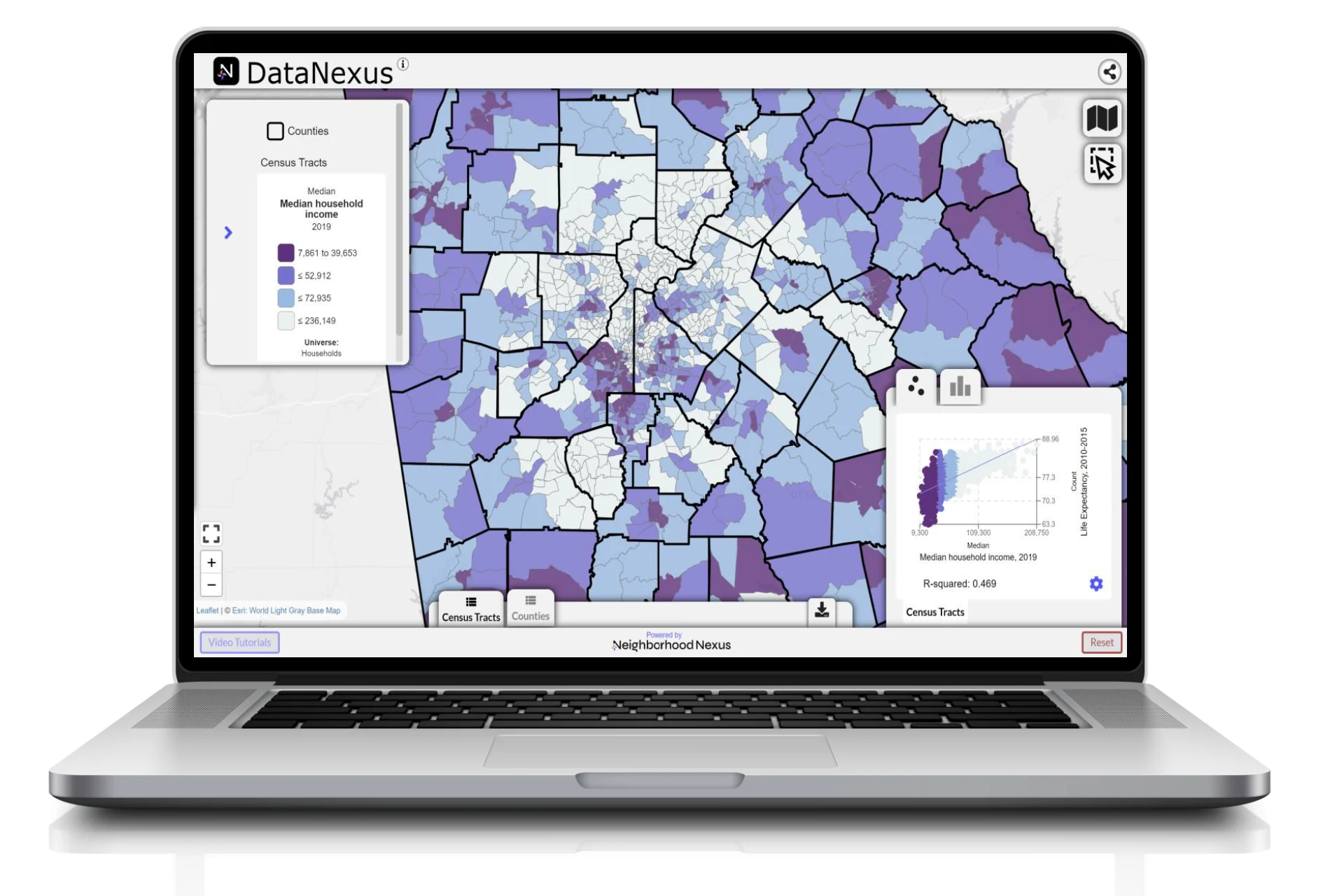
More than 600 variables from nine different sources. Use this site to explore neighborhood level trends. |
![]() |
|
|
More than 200 variables from the U.S. Census Bureau. Use this site to explore socioeconomic and demographic data by legislative district. |
![]() |
|
|
About 100 variables from the GA Department of Education. Use this site to explore student achievement, socioeconomic and demographic data by Elementary and Middle School. |
|
|
Mapping Assets Using Google"Asset mapping" provides another way to spatially understand our environment by putting service providers "on the map". Using this, you can determine if there are sufficient services that are covering your area of interest. Caution is urged, however. As soon as an "asset" map goes live, it is out of date, because places open, close and relocate all the time. |
||
| Portal | What is it mapping? | Image |
|
In a partnership with the United Way of Greater Atlanta, almost 1,300 service providers are mapped from United Way's 2-1-1 database. The list has five issue areas: Basic Needs, Education, Health, Homelessness and Income. |
![]() |
|
Below are some examples of maps you can make with Weave. We made these maps, but are very interested in some of the maps you create. Please email us your creations, along with a one-to-two sentence story about it, and we'll post it and give you credit for it! Or go to Neighborhood Corner and leave your story there.